2024 – 2025 · Research & experimentation · Marketplace
Login
Very few people browsing Fotocasa ever signed in. Over a year of research and A/B tests, we worked on two fronts: where we ask people to sign in, and how easy it is to get in.
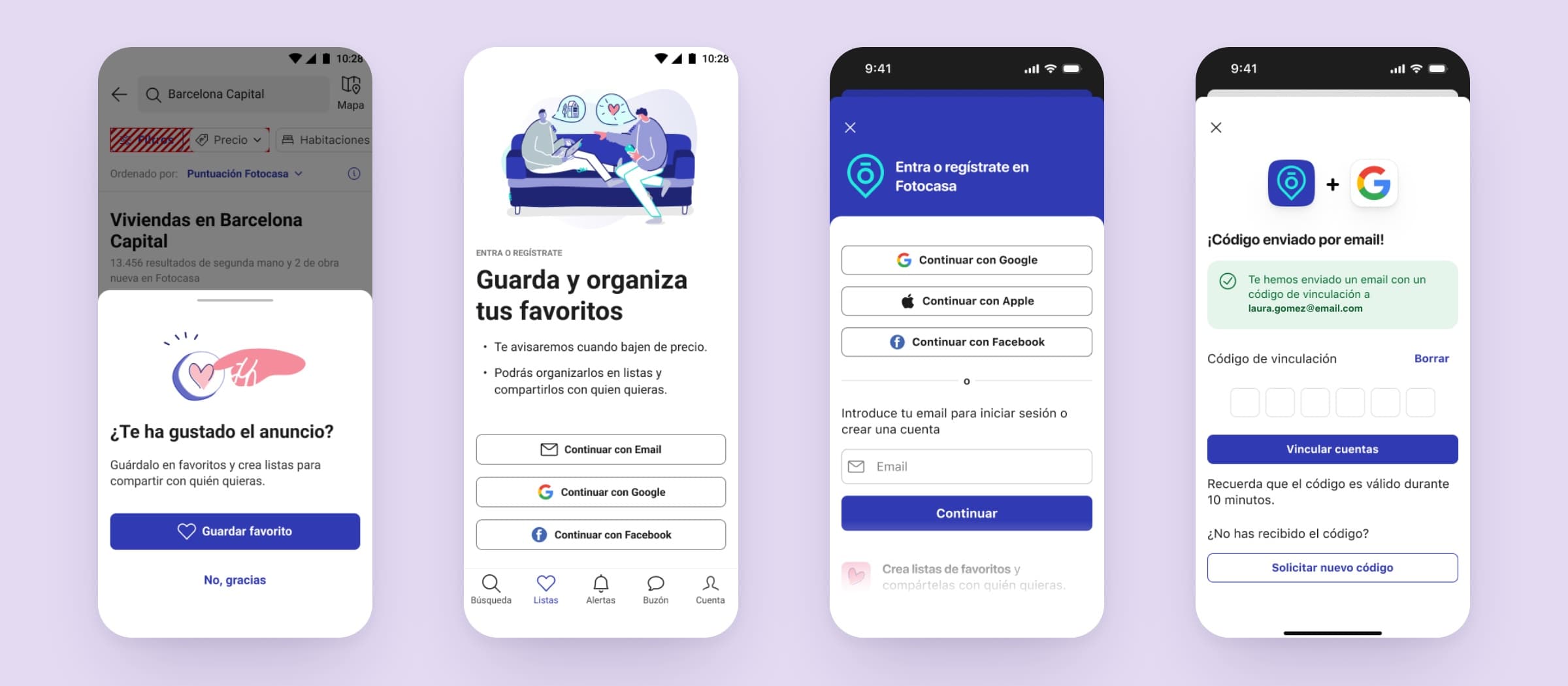
An account is what makes Fotocasa useful over time — favourites, alerts, conversations with advertisers. Yet most visitors never signed in, and the login gave them no reason to: one generic screen, the same from everywhere.
It wasn’t one screen to redesign. It was a programme: research to find out why people sign up and what stops them, designs for each moment, and an A/B test for almost every change. I worked on it from the survey to the last iteration, across iOS, Android and web.
Two fronts
Everything we tried answered one of two questions.
01 Where we ask
- After sharing an ad
- On the home page and in the results list
- Coming from an alert email
- After contacting an advertiser
- In My account, with a login wall that says what you get
02 How easy it is to get in
- Social login first
- Link an existing account with a code, not a password
- A button that says “Sign in”, not “Continue”
- Fewer errors in the form
Ten experiments and three rounds of research, from May 2024 to June 2025.
What research told us
A survey across four generations and sixteen interviews pointed at the same few things.
- The password is the wallforgetting it is the main problem when signing in, at every age.
- People forget how they joinedone in four don’t remember whether they used email or a social account.
- Favourites are the reasonsaving homes is what makes people create an account; contacting comes second.
- Age changes the way inolder people stick to email; the youngest prefer social login.
- Spam puts people offthe fear of emails and the safety of their data are what stop them.
How we decided
Every change went out as a test, and each result had a clear next step.
- It winsit ships.
- No differenceit ships if the health metrics hold — the experience is better, and nothing got worse.
- It losesit’s rolled back, and we learn why before trying again.
Under NDA
The full case
The baseline, the survey in numbers, every test with its result — including the ones we rolled back — and what I’d do differently. Password protected — I share it by message.